
Vinton County Projected Release Dates
ODRC's exact public label is “Expected Release Date/Parole Eligibility Date.” The combined wording matters. For a definite sentence, the value may be a projected calculation. For a parole-eligible sentence, it may mark the first time the person can be considered by the Parole Board. Eligibility is not approval. A Board recommendation also can remain conditional until physical departure.
An actual release date records an event that happened. It should align with the current status and a Parole or Release Detail, court journal entry, or custodial release record. If ODRC still shows “Incarcerated” after a predicted date, the public record does not confirm release. For a person held only at Southeastern Ohio Regional Jail, ODRC is the wrong system.
Scheduled versus actual: A future date estimates or authorizes a possible event. Current status and the custodian's departure record confirm the event.
| Situation | Date source | What confirms departure |
|---|---|---|
| Pretrial SEORJ detention | No fixed sentence date; court action controls | SEORJ release entry plus court order |
| Local jail sentence | Sentencing court and jail calculation | SEORJ departure record |
| ODRC definite term | Expected Release Date field | Released status and release detail |
| Parole-eligible term | Parole Eligibility Date or Board action | Later ODRC release status |
Lookup Vinton County Release Dates
Classify the custody before searching. The shared regional jail holds local detainees, while ODRC covers state prison sentences. The Vinton court docket links either route to the underlying case. Matching a name alone is unsafe because one person can have several bookings or county commitments.
- For a state prisoner, open ODRC Offender Search. Search by name or the letter-and-number ODRC identifier.
- Choose Vinton as County of Commitment when the result set needs narrowing. Compare date of birth, docket, offense, judge, admission, sentence, and jail-time credit.
- Read the complete “Expected Release Date/Parole Eligibility Date” label, current status, Parole or Release Detail, and any next Board hearing month.
- For a local SEORJ sentence, contact the jail and sentencing court. Ask for the calculation and the existing release entry rather than applying a state-prison formula.
- For judicial release, retrieve the Vinton Common Pleas journal entry and then confirm ODRC's changed status.
- Recheck after the predicted date. A remaining Incarcerated status means no public confirmation of release.
The Vinton County Court bond and waiver schedule does not supply a projected sentence end. Much of that material concerns traffic waivers and required appearances. A listed sum cannot prove bond was posted or that the jail discharged a named person.
The official County Court schedule demonstrates why a posted amount must be separated from a completed release.
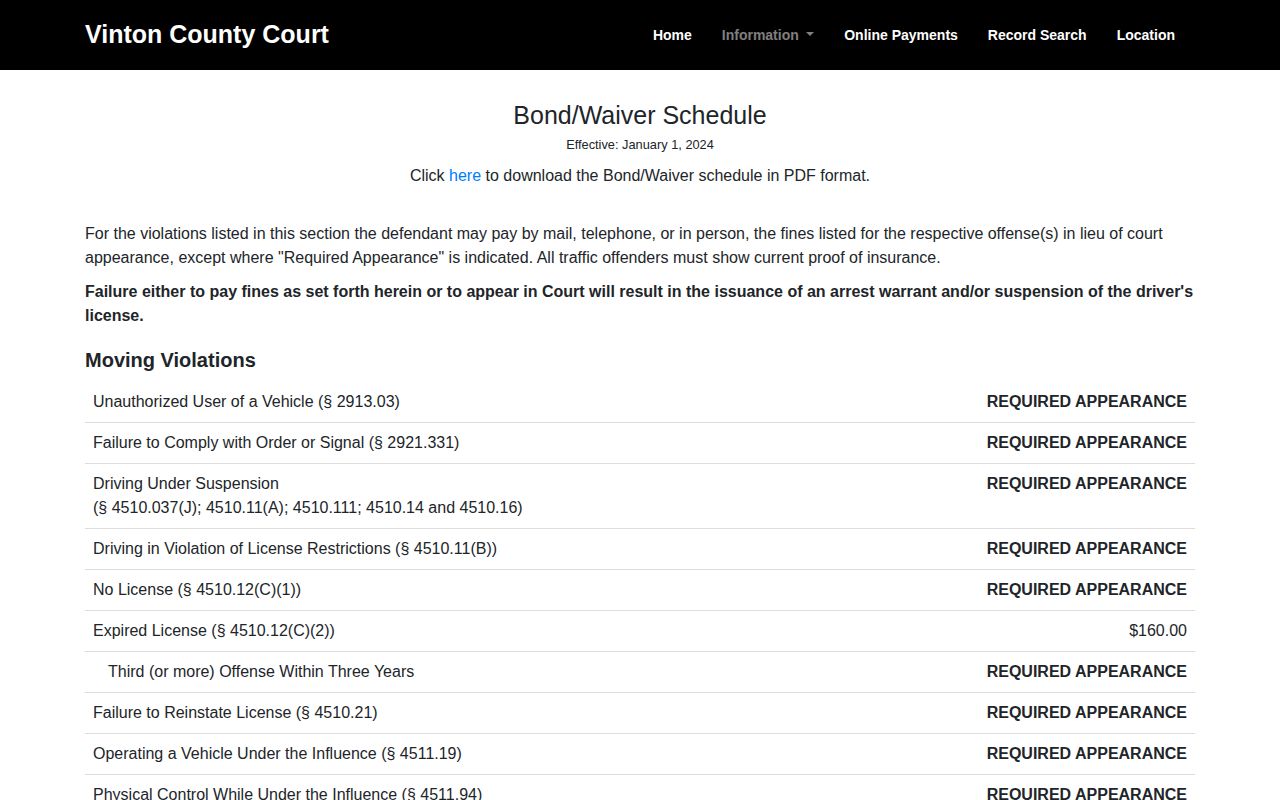
The case order and SEORJ release entry, not the schedule alone, establish what happened in a specific case.
A Vinton docket can answer a different part of the timing question. Bond, dismissal, sentencing, jail-time credit, commitment, judicial release, and community-control entries show the court's legal action. They do not show the exact hour SEORJ carried out an order. County Court warns of web delay, and Common Pleas also cautions that posting may lag. When timing matters, ask for the journalized order and then call the custodian. This two-record check is stronger than assuming a missing roster name proves the predicted event occurred.
Use Vinton Common Pleas eServices for a felony order and the SEORJ contact page for physical departure. Sheriff Ryan Cain's official Sheriff's Office page supplies the county arrest-record contact when the custodian is unclear. If the order sent the person to the Ohio Department of Rehabilitation and Correction, return to ODRC for the state calculation and later release status.
Note: County Court web information can trail filings or judicial action by at least 24 hours and sometimes longer.
Vinton County ODRC Date Labels
Several ODRC abbreviations point to milestones, not accomplished freedom. “POA Date” means parole on or after. “PRD” means projected release date. “Earliest Possible Transfer Date” concerns transitional control and may indicate movement within a correctional process rather than discharge to the community. “Expired Stated Term” reflects the imposed term after applicable jail credit.
The public ODRC definitions explain those distinctions and the combined expected-release/parole-eligibility field. A Board projected release date is a conditional future action. The Board may continue a hearing, deny parole, rescind action, or require further review. Modern definite and non-life indefinite terms also follow different rules from traditional parole-eligible life or older sentences.
- Projected release date
- A calculated future date that can change before custody ends.
- Parole eligibility date
- The point when consideration may begin, not a promise of release.
- Judicial release
- A sentencing court's order moving an eligible state prisoner into community control.
- Detainer
- A request or authority that can cause transfer to another custodian instead of release home.
ODRC's official definitions display explains the expected-release field and state status vocabulary.
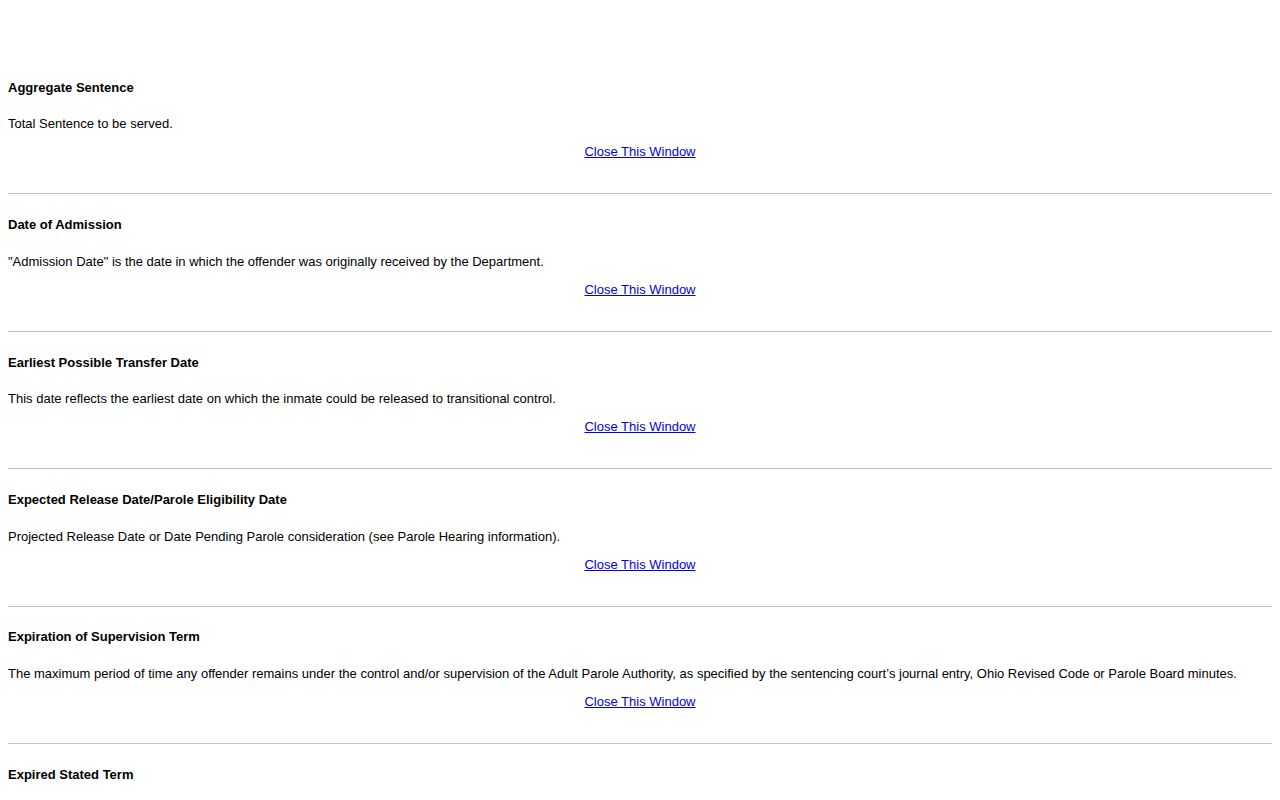
Use the definitions beside the individual record so a date label is not mistaken for an actual departure.
Ohio Earned Days for Vinton Releases
Ohio law does not support a blanket statement that every state prisoner serves 85 percent of a term. Current ORC 2967.194, for confinement beginning April 4, 2024, creates earned days for eligible state prisoners. It allows provisional credit of one or five days for each completed month of productive participation in approved programs or activities. Completion of a second activity may add up to five days. Listed milestones may yield 90 days or ten percent of the stated term, whichever is less.
The ordinary participation and completion-credit total, apart from the special milestone rule, cannot exceed 15 percent of the stated term. That ceiling explains the common 85-percent shorthand for some eligible definite terms. It is not a guarantee. The law excludes irreducible terms and specified serious sentence types, including death, aggravated murder or murder categories, life without parole, and specified sexually oriented terms. Mandatory portions and sentence structure still control.
For eligible non-life indefinite terms under the covered framework, awarded days can apply to both minimum and maximum terms. Former ORC 2967.193 applies to earlier confinement, and OAC 5120-2-06 supplies implementation detail. Credit remains provisional until handled under the governing process and can be disallowed or withdrawn.
The current earned-credit statute is shown in the official Ohio code capture.
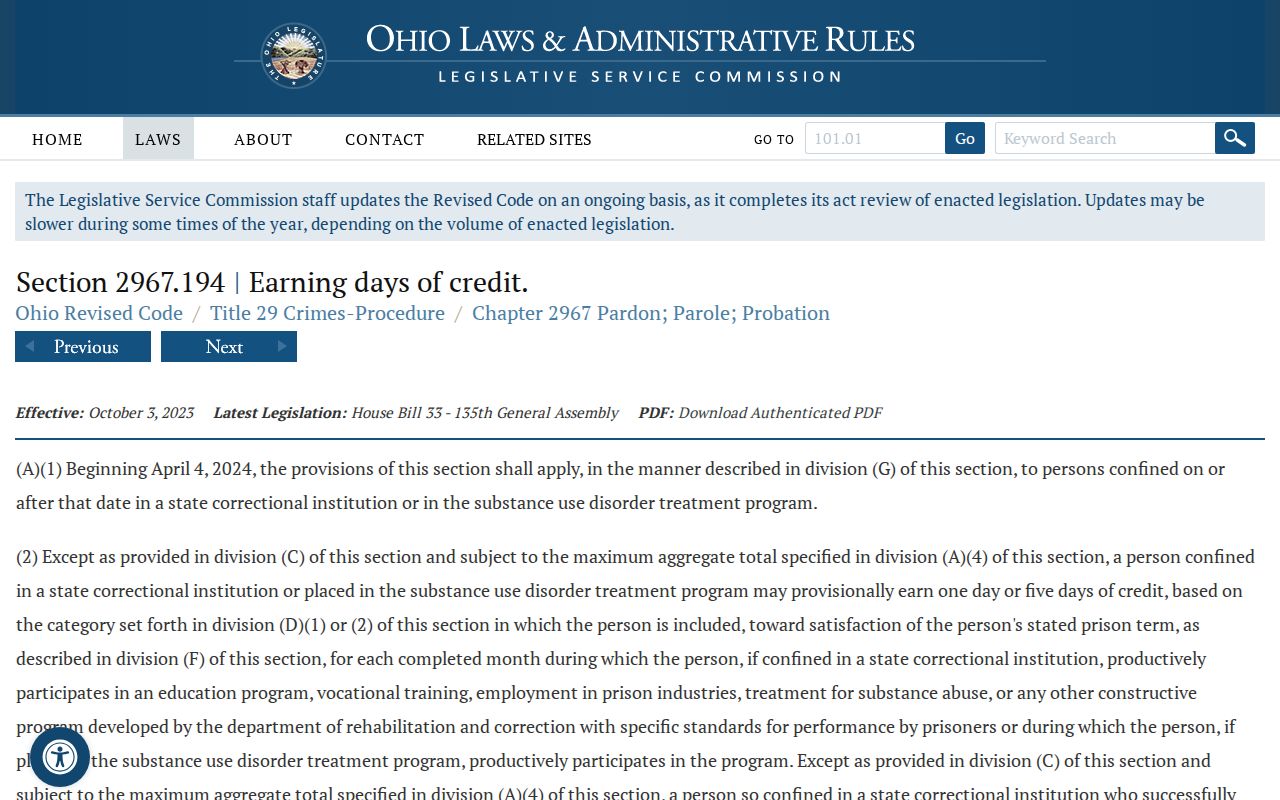
The statute's eligibility rules and exclusions must be read before estimating a Vinton state-prison date.
Credit is only one input. The court's stated term, mandatory portion, jail-time credit, and decision to run terms at the same time or one after another must be known first. ODRC then applies the law and its records to that sentence. A percentage taken from the total sentence cannot reproduce the official calculation when eligibility or sentence structure differs. For that reason, use the statute to understand the framework and the offender detail to read the current projection. Ask ODRC or the sentencing court about an unexplained change.
Why Vinton Release Dates Change
A release calculation is a snapshot. New court orders, the sentence structure, and later correctional action can move it. The source for each change also differs, so a reader should not expect one public field to explain every adjustment.
| Factor | Possible effect | Record to check |
|---|---|---|
| Jail-time credit | Credits qualifying days already held | Sentencing entry and ODRC sentence data |
| Concurrent or consecutive terms | Changes how multiple terms combine | Court judgment |
| Earned days or sanctions | May shorten a term or remove provisional credit | ODRC calculation and governing rules |
| Parole Board action | May grant, continue, deny, or condition a date | Board result and later ODRC status |
| Judicial release | Can move an eligible person into community control | Common Pleas journal entry |
| Detainer or another case | Can lead to continued custody or transfer | Jail, court, and receiving-agency records |
| Non-life indefinite sentence | May permit confinement beyond the minimum in statutory cases | ORC 2967.271 and ODRC record |
Do not import ODRC earned-day rules into SEORJ. The public jail material does not state a Vinton-specific local good-time formula or a weekend or holiday early-release practice. A Sunday date does not automatically become Friday based on any source in the Vinton research. Ask the sentencing court and jail for the actual calculation.
Vinton Release Date Milestones
Vinton's key date quirk is the ODRC label itself. It places a calculated release date and a parole-eligibility milestone in one field. A reader must decide whether the record describes a definite term, eligibility for Board consideration, a conditional Board date, transitional control, or an actual status change. Those are five different events.
When a parole hearing applies, inspect the next hearing or review month and the latest result. A continuation means more review, not release. When judicial release applies, use the Common Pleas journal. When the sentence is local, use SEORJ and the Vinton court. This custody-based split prevents a state prediction from being assigned to a person who never entered ODRC.
Confirm Vinton County Release Dates
After noting a projected date, check the record again near and after that date. For ODRC, current Released or APA Supervision status and the release detail are stronger than the old prediction. For SEORJ, call 740-753-4060 and request the effective departure date and disposition. The court docket identifies the legal authority, while the custodian identifies physical departure.
Ohio VINE can send a custody-event alert when the reporting agency supplies the record. Registration steps and event limits are covered in the VINE Inmate Check. Treat an alert as a prompt to verify. A Transfer event can mean custody continues, and delayed delivery can make an alert unsuitable as the sole source for a time-sensitive decision. Adult Parole Authority supervision may follow an ODRC release, but it does not convert the projected field into an actual departure record.
Note: A Vinton release is confirmed only after the current custodian's status and the relevant court or release record agree.
Public Record Search
Sponsored Results