
ODRC Release Status Destinations
ODRC is a statewide prison and supervision system, not a facility located in Vinton County. A Vinton felony case can send a sentenced person from Southeastern Ohio Regional Jail into an ODRC institution. That transfer ends local jail custody but does not release the person. The ODRC record should then identify the institution and show an incarcerated status until a later prison event.
Leaving prison can lead to judicial release into community control, parole, post-release control through the Adult Parole Authority, full discharge, another custodian, or another defined result. “Released” must be read with its subtype because ODRC also uses labels such as “Released - Death.” A person on APA Supervision is outside prison but has not completed all state control. A sentencing-court entry supplies an essential cross-check for judicial release and other court-driven outcomes.
| ODRC status | Custody meaning | Next check |
|---|---|---|
| Incarcerated | Still an ODRC prisoner | Institution and sentence detail |
| Released | A defined release event is recorded | Subtype, release detail, and court docket |
| APA Supervision | Out of prison under state supervision | Supervision dates and listed APA office |
| Violator at Large | APA identifies an absconder | ODRC warning and current agency information |
| Judicial Release | Court-ordered prison release into community control | Common Pleas journal entry |
Search ODRC Vinton Releases
The public ODRC Offender Search accepts a last name, first name, County of Commitment, Residential County, ZIP code, status, next parole-board hearing month, or ODRC number. A name search works with a last name alone, and fewer filters can produce a better first pass. Surname matching is broad, so a partial value can return longer names. Compare the record's identifiers instead of selecting the first result.
- Open the official ODRC Offender Search and enter the person's name or full ODRC number.
- Select Vinton under County of Commitment when the sentencing county is known.
- Run a Released search, then repeat with APA Supervision if ongoing state control is possible.
- Open the detail and compare identity, Vinton docket, offense, judge, admission, and sentence information.
- Read the current status with Parole or Release Detail and check the Common Pleas journal entry.
A real public ODRC example from a Vinton committing case is labeled “RELEASED - Judicial Release” and carries a Vinton docket, admission facts, jail-time credit, sentence data, and photograph. It proves that the state search can retain a released prison record linked to Vinton. It does not mean every released SEORJ detainee enters ODRC. The Vinton County search and release-record route covers cases that stayed local.
ODRC Release Record Fields
An individual result may show name, ODRC number, photograph, demographic identifiers, admission date, institution, current status or release reason, offenses, sentence data, committing county, docket, judge, and jail-time credit. Later sections can include the combined “Expected Release Date/Parole Eligibility Date” label, Parole or Release Detail, a supervision start date, supervision period, APA office, conditions, and hearing information. Not every record includes every field.
- Discharge
- The end of the applicable correctional or supervision obligation, as shown by the governing record.
- Judicial release
- A sentencing court's early release from prison into community control.
- Parole
- Conditional release from prison under state supervision for an eligible sentence.
- Post-release control
- A period of APA supervision after prison under Ohio law and the sentence.
- Jail-time credit
- Qualifying prior confinement credited toward the prison sentence.
The combined expected-date and parole-eligibility label requires care. It can be a projected date for a definite term or the first date an eligible person may be considered for parole. “POA” means parole on or after. “PRD” means projected release date. “Earliest Possible Transfer Date” concerns transitional control and does not necessarily mean community discharge. A past or future date without a matching present status does not by itself prove actual release.
Supervision dates need the same discipline. “Expiration of Supervision Term” is the maximum period shown for APA control, while “Supervision End Date/Early Termination” can record an earlier end. A supervision start date helps place the person outside prison, but it does not by itself prove final discharge. Read the current status, supervision period, release detail, and end fields as a group. When the Vinton court ordered judicial release, the journal entry may also impose community-control terms that belong to the court rather than APA.
Read ODRC Release Results
The official ODRC definitions page explains how status and date labels should be read. The captured page below preserves those agency definitions for comparison while reviewing a result.
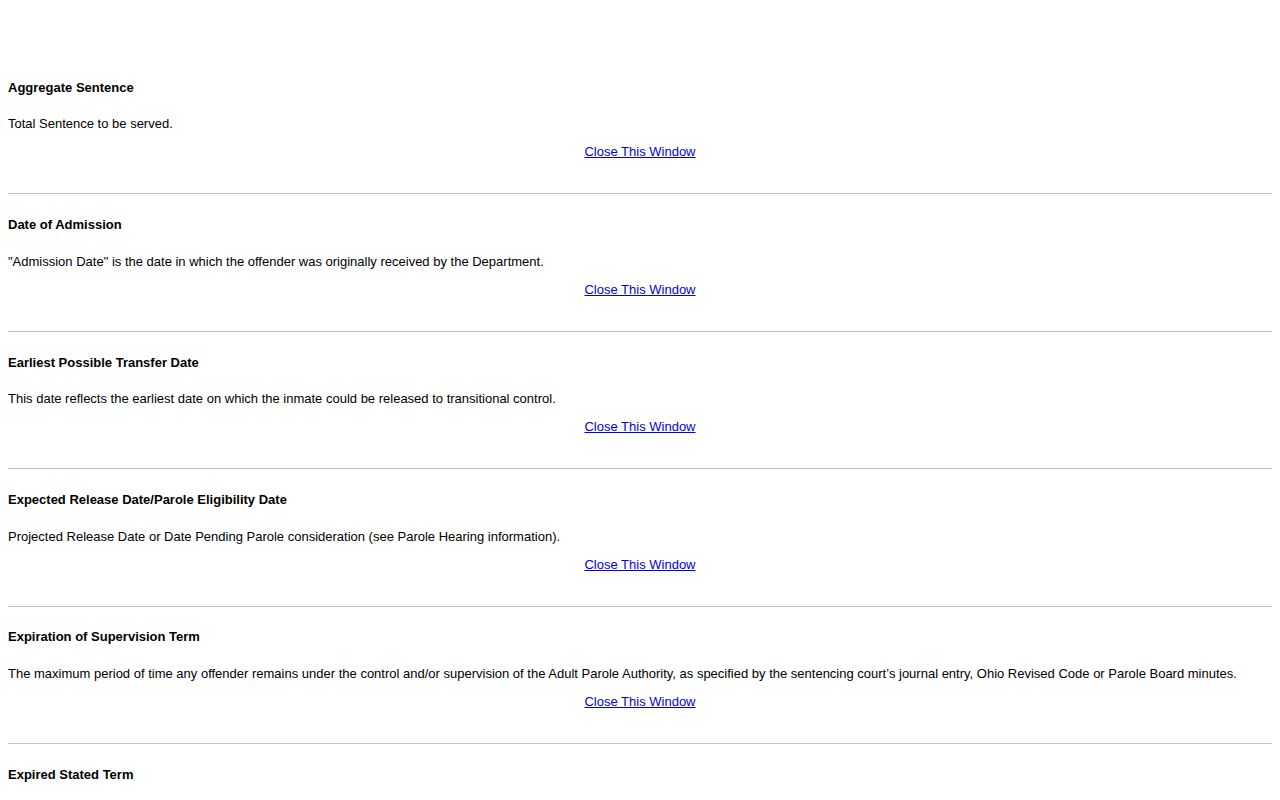
The definitions prevent a common error: treating projected timing, parole eligibility, transfer timing, and completed release as the same event. Present status and release detail carry more weight than an isolated date field.
ODRC itself warns that sentencing information can be incomplete. One supervision period may also relate to another offense. Compare the committing county, docket, judge, offense, admission date, and sentence with the Vinton Common Pleas file. If the page shows an APA office, use the office on the individual record instead of assigning the person from an old county directory.
ODRC Release Records Contact
The research did not identify a specific state prison in Vinton County, so no local institution address can be supplied. Public detail pages direct questions to ODRC Central Records in Columbus. Use the offender search and sentencing docket first. A focused question with the ODRC number and docket helps staff identify the record at issue.
ODRC Central Records
Mail: Ohio Department of Rehabilitation and Correction
Attn: Central Records
P.O. Box 430
Columbus, OH 43216
Search: ODRC Offender Search
Ohio Revised Code 5120.21(E)(1) excludes records about ODRC inmates and APA-supervised people from the ordinary Public Records Act. The public search is a selected disclosure, not access to the complete correctional file. The office may apply confidentiality rules, identity limits, or other restrictions to a request. Parole Board records follow their own rule and process. Do not promise a full file or a fixed response schedule that the research does not state.
ODRC Vinton Release Court Check
The Vinton Common Pleas docket is the proper court bridge for a felony sentence. It may show commitment to ODRC, jail-time credit, sentencing terms, judicial-release motions and orders, community-control conditions, violations, and termination. A judicial-release label in ODRC should line up with the sentencing court's journal entry. The state status tells what ODRC recorded; the journal tells what the court ordered.
The electronic Common Pleas index begins January 1, 1998 and can have posting delay. Older, sealed, expunged, juvenile, confidential, or restricted matters may not be public online. Absence from the docket or offender search is not proof no record ever existed. A precise clerk or ODRC inquiry remains the fallback when a known case cannot be reconciled.
Use the Vinton docket number shown on the ODRC detail whenever possible. Compare the sentence, offense, judge, admission date, and jail-time credit before joining the two sources. A person may have cases in more than one county, and ODRC warns that sentencing data can be incomplete. County of Commitment is a search aid, not a substitute for identity matching. If supervision arises from another offense, the displayed residential county also should not be treated as proof that Vinton imposed the supervision.
ODRC and SEORJ Releases
A released Southeastern Ohio Regional Jail detainee and a released ODRC prisoner follow different record routes. SEORJ is the regional local jail for Vinton arrests. ODRC holds sentenced state prisoners and supervises certain people after prison through the Adult Parole Authority when applicable. A person who posted county-jail bond may never appear in ODRC. Conversely, someone transferred from SEORJ to prison has left the regional jail but remains incarcerated in the state system.
Ohio VINE may send custody or release notifications for participating agencies, but it is not a historical release archive. A VINE transfer event should point the search toward the receiving agency. The current ODRC result, the prison release detail, and the Vinton Common Pleas docket route are the stronger sources for state custody. For a live question, confirm each stage with the agency that created it.
The SEORJ roster can help establish the local booking and arresting agency before state commitment. If Sheriff Ryan Cain's office made the arrest, its official Vinton County page supplies the local contact. The roster should not be used to measure a later prison term. Likewise, ODRC's intake photograph and prison record do not replace a requested SEORJ booking image or local release entry. Keeping each document tied to its source preserves the actual sequence from local detention, through state admission, to prison release or supervision. Record the source and retrieval date when statuses change.