
BOP Release Status Destinations
The Bureau of Prisons runs the federal correctional system. No federal prison was identified in Vinton County, and the BOP page should not be read as a local facility page. Its relevance begins only when a federal prosecution or sentence placed the person in BOP custody. A past federal prisoner may have lived in Vinton County, been arrested elsewhere, served time in another state, and completed custody without ever appearing on a Vinton jail record.
After BOP custody, a person may return to the community while subject to federal supervised release or parole. Another criminal-justice or immigration system may also hold the person. The locator describes BOP status, not every possible legal constraint or physical destination. A federal release date should therefore be compared with the federal court docket and any known local, state, or ICE record.
| Locator display | What it supports | What it does not prove |
|---|---|---|
| Past Release Date, no facility | BOP says release occurred on that date | Return to Vinton County |
| Location “RELEASED” | No longer in BOP custody | End of federal supervision |
| Future Release Date | Projected federal timing | Completed release |
| “IN TRANSIT” | Movement within a custody process | Release to the community |
| “UNKNOWN” | Timing is not determined | A hidden or completed release |
Search Federal Release Records
The BOP Inmate Locator covers people within its stated record scope, including many former federal prisoners released after 1982. A register number is the strongest search key when it is known. The biographical search accepts a name and narrowing details. Variants, suffixes, and data differences can affect results, so compare the returned number, age, race, sex, location, and date rather than relying on a name alone.
- Open the official BOP Inmate Locator and choose number or name search.
- Enter the full BOP register number, or use the exact name with available narrowing details.
- Open the matching result and read Location and Release Date together.
- Distinguish a past date from a future projection, “UNKNOWN,” and “IN TRANSIT.”
- Check the federal court docket or BOP records route if the result does not answer the release question.
The official BOP Inmate Locator is the direct public search. Its captured landing page appears below.
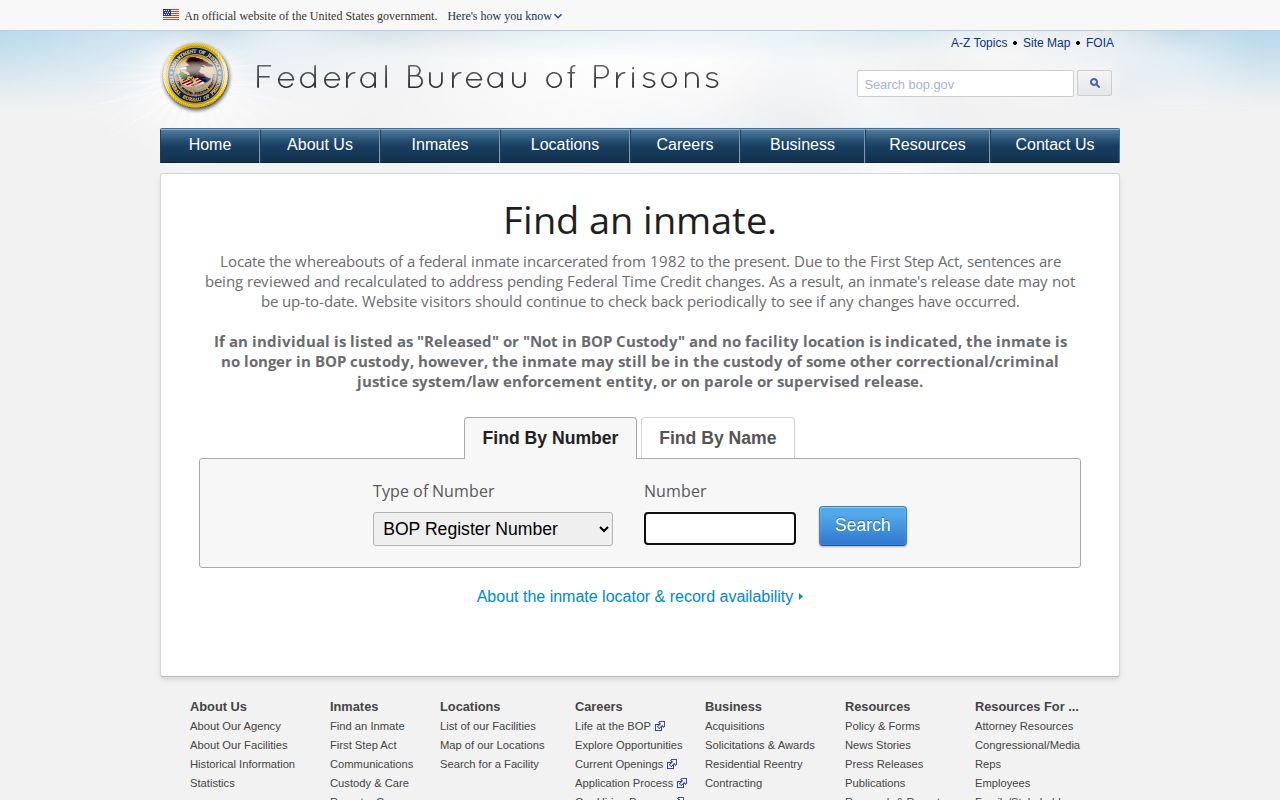
The locator is a federal source. It cannot confirm a release from Southeastern Ohio Regional Jail, an ODRC institution, ICE detention, or a local Vinton court case that never became federal.
Interpret BOP Release Fields
A past Release Date paired with no institution location means the agency records the person as released from BOP custody on that date. A Location field of “RELEASED” communicates the same custody boundary. A future date is a projection and can change. “UNKNOWN” means timing has not been determined in the public result. “IN TRANSIT” signals movement and should never be recast as release home.
- BOP custody
- Confinement or placement administered by the Federal Bureau of Prisons.
- Supervised release
- Court-ordered federal supervision in the community after imprisonment.
- Projected date
- A future estimate, not proof that physical release has occurred.
- Register number
- The federal identifier used to distinguish one BOP record from another.
- Federal pretrial detention
- Custody before case resolution, often managed by the U.S. Marshals rather than BOP.
The BOP cautions that a person outside its custody can remain under federal supervision or appear in another justice system. “Not in BOP custody” is a system-specific statement. If an ICE detainer, state warrant, local case, or U.S. Marshals movement is documented, check that source separately. The ICE and U.S. Marshals custody page explains those distinct routes.
Identity checks matter because the locator is nationwide. Compare the register number and biographical fields, then use the federal case number to connect the result to a court judgment. A Vinton residence is not the same as a Vinton prosecution, and a person can serve a federal sentence at several institutions. The facility shown before release identifies a BOP placement, not the county to which the person went afterward.
Request Federal Release Records
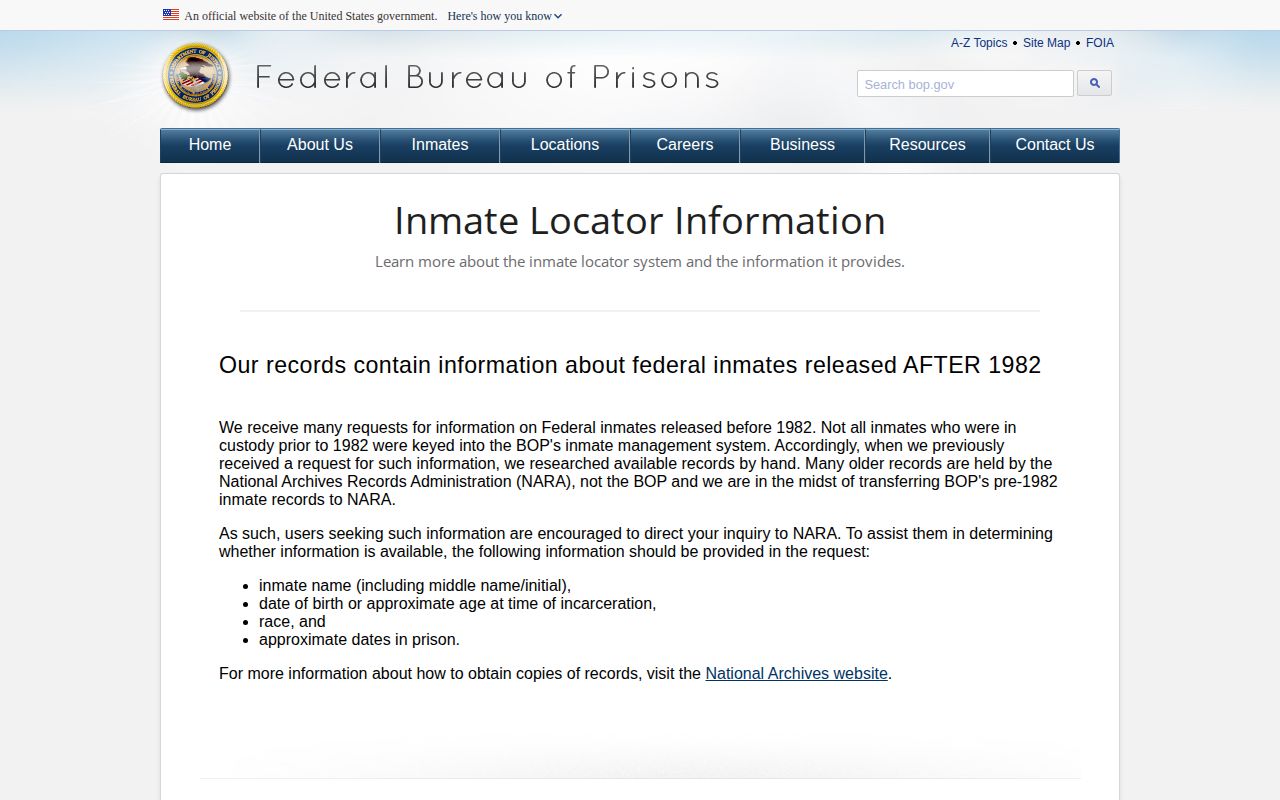
The public locator offers a concise status, not a full correctional file. BOP's records explanation says its locator data come from the agency's main database and are updated daily. Older federal records, especially outside the locator's stated period, may require the National Archives. Recent records not shown in the locator can be addressed through the BOP Freedom of Information Act process, subject to the Privacy Act and identity or authorization limits.
The BOP explanation of federal inmate records describes the public locator's source and limits. The captured agency page below helps distinguish a locator result from a full file.
A records request should identify the person, register number, date range, institution if known, and the exact existing record sought. Broad questions asking BOP to reconstruct a life history are less precise than a request for a release-date record or designated custody entry.
Privacy rules may limit access to another person's records. Proof of identity, consent, authorization, or proof of death can matter depending on the request. The public locator remains the fastest first step because it was built to expose selected status and release fields. No response time or outcome should be promised beyond the agency's published process.
BOP Release Records Contact
The research identifies a nationwide system and public web routes, not a Vinton County BOP institution. A made-up local prison address or local BOP phone would be misleading. Use the agency locator for the public status and the BOP FOIA channel for records beyond it. The sentencing federal court is the source for the judgment and supervised-release terms.
Federal Bureau of Prisons
Public locator: BOP Inmate Locator
Records route: BOP Freedom of Information Act page
Coverage: Federal prison records within the agency's stated scope
If the underlying case was prosecuted in the Southern District of Ohio, the federal court docket can identify the judgment, custody order, sentence, and supervised-release term. The docket does not replace the BOP's operational custody record. Use both when the question asks not only whether prison ended, but which legal obligations followed.
Federal Pretrial Release Records
A person held for a federal case before sentencing may be managed by the U.S. Marshals in a contract facility. That person may never appear as a BOP inmate. Vinton County lies within the federal Southern District of Ohio, whose U.S. Marshals headquarters is in Columbus. The Marshals manage federal prisoner processing, placement, movement, safekeeping, and disposition, but their tracking system is not a public name locator.
The federal docket is the best public route for detention and release orders. The district Marshals office may provide information it can lawfully disclose. If a local roster shows a federal hold and the name then disappears, ask the local jail whether the Marshals took custody. That event is a transfer, not a BOP release, and it should be followed through the federal case.
A docket order and a physical custody change can occur at different times. The order states the court's direction, while the Marshals or holding facility completes the movement. Use the case number, defendant identity, order date, and custody contact together. If sentencing results in BOP commitment, the register number and later locator entry become the continuing federal prison record.
BOP and Vinton Releases
Three systems must remain separate. Southeastern Ohio Regional Jail documents local jail custody for Vinton arrests. The Ohio Department of Rehabilitation and Correction documents state prison custody, with its Adult Parole Authority handling applicable state supervision. BOP documents federal prison custody. Search the system named by the charge, sentence, transfer entry, or court docket. A similar name in a different system is not enough to join the records.
A person can also move between systems. SEORJ might release someone on a Vinton bond, transfer a sentenced person to ODRC, or hand a person with a documented federal hold to the Marshals. If Sheriff Ryan Cain's office made the arrest, its official Vinton County contact page identifies the arrest-side source. Later BOP release may occur far from Ohio. Each agency record confirms only its stage. Build the complete sequence from verified identifiers and dates, not assumptions about geography.
Ohio VINE and the SEORJ roster are not BOP release databases. A VINE alert tied to local or state custody cannot fill a federal locator gap. The Vinton Common Pleas Clerk supplies the local felony docket route, not federal prison status. Similarly, BOP's daily data update does not establish how fast a local court or jail posts its own record. Respect each source's update cycle and coverage, then contact the originating agency when dates appear to conflict. Note the federal register number with each saved result.