
Federal Transfer Release Paths
An SEORJ departure can lead to the community, but it can also lead to another custodian. If a jail entry, court file, or agency response identifies an ICE detainer or U.S. Marshals hold, the person may leave the regional jail while custody continues. The SEORJ release or transfer record should identify the departure type and, when recorded, the receiving agency. That fact controls which federal route comes next.
ICE custody may end through conditional release or bond, removal, voluntary departure, a case resolution that permits the person to remain, or transfer to another law-enforcement custodian. U.S. Marshals custody can end through a federal release order, commitment after sentencing, return to another custodian, or movement in the federal process. None of these paths can be inferred merely because a name is absent from a local roster.
| Record clue | Correct route | Main limit |
|---|---|---|
| ICE detainer or transfer | ICE Online Detainee Locator | A no-custody result has several meanings |
| Federal pretrial hold | Federal court docket and U.S. Marshals district | No public USMS name locator |
| Federal prison sentence | BOP Inmate Locator | Not every pretrial detainee enters BOP |
| SEORJ roster removal only | SEORJ release or transfer record | Absence does not identify a federal agency |
Search ICE Release Status
The ICE Online Detainee Locator offers two basic search routes. An A-number search uses the immigration identifier and country of birth. A biographical search uses the person's exact name and country of birth, with date of birth available to narrow the result. People under 18 do not appear. Safety and security restrictions can also suppress a record, so a failed search is not a final custody finding.
- Confirm that a jail, court, attorney, or agency record actually points to ICE custody.
- Search the ICE locator with the complete A-number and country of birth when available.
- If the number is unknown, use the exact biographical spelling, country of birth, and date of birth.
- Read the result as an ICE-specific status, not a finding about all federal or local custody.
- Use the ICE check-in office directory or known field office to verify ongoing reporting or a recent booked-out event.
The official privacy assessment describes locator coverage of current detainees and people booked out during the preceding roughly 60 days. Updates can lag by hours. Once the recent booked-out period passes, an old record may age out of the public result. A “not in custody” result can therefore describe several outcomes or simply a record beyond that display window.
Interpret ICE Release Results
ICE's public locator is a current and recent status tool, not a complete historical release database. The strongest match uses the A-number, country of birth, and identity details. If only a name is available, spelling, compound surnames, and date-of-birth differences can affect the search. Agency or attorney confirmation is especially important when a known recent transfer returns no result.
- A-number
- The immigration identifier used to distinguish a person in Department of Homeland Security records.
- Detainer
- A request or notice tied to another agency's custody decision; its exact legal effect depends on the record.
- Booked out
- An ICE record indicating departure from a detention booking, without one universal destination.
- Conditional release
- Release from detention subject to stated immigration conditions or reporting duties.
- Removal
- Departure from the United States under immigration authority, not community release in Ohio.
An ICE check-in office can be the continuing contact after some non-detained outcomes. The directory is not a public archive and does not establish where a person lives. Use it to identify the office handling reporting, then ask what can lawfully be confirmed. Court records or case representatives may be needed to explain a result that the locator compresses into a short status.
Check U.S. Marshals Release
The U.S. Marshals Service manages many federal pretrial prisoners and movements, often through contract detention space. Its Prisoner Tracking System description covers processing, placement, safekeeping, care, and disposition through commitment, release, or return to another custodian. That system is not a public person-by-person locator. A detainee held for the Marshals may never appear in the public BOP search.
Vinton County lies in the Southern District of Ohio. The federal court docket is the most useful public route for detention orders, release conditions, plea and sentence events, or commitment. The district Marshals office may provide custody information it can lawfully disclose, especially when the federal case number and full identity are available. If SEORJ reports a Marshals pickup, preserve that transfer fact and continue through the federal docket.
U.S. Marshals, Southern District of Ohio
Address: 85 Marconi Boulevard, Room 460, Columbus, OH 43215-2885
Phone: 614-469-5540
Official source: Southern District of Ohio
A federal court order can authorize release but may not state the hour that a contract jail completed processing. Likewise, a Marshals transfer after sentencing may deliver the person to BOP rather than the community. The operational record and court order answer different questions and should be read together.
ICE Release Contact Channels
No ICE detention facility or field office was identified in Vinton County by the research. A local address must not be invented. Use the nationwide locator first, then the official check-in directory to identify the relevant office. The directory can help a person comply with or ask about continuing reporting, but it does not display a public release history.
ICE Custody and Check-In
Detainee search: ICE Online Detainee Locator
Office finder: ICE check-in office directory
Coverage: Current detainees and a limited recent booked-out window, subject to restrictions and delay
The official check-in directory is shown in the matched captured image below. It is an office-routing source rather than proof of detention or release.
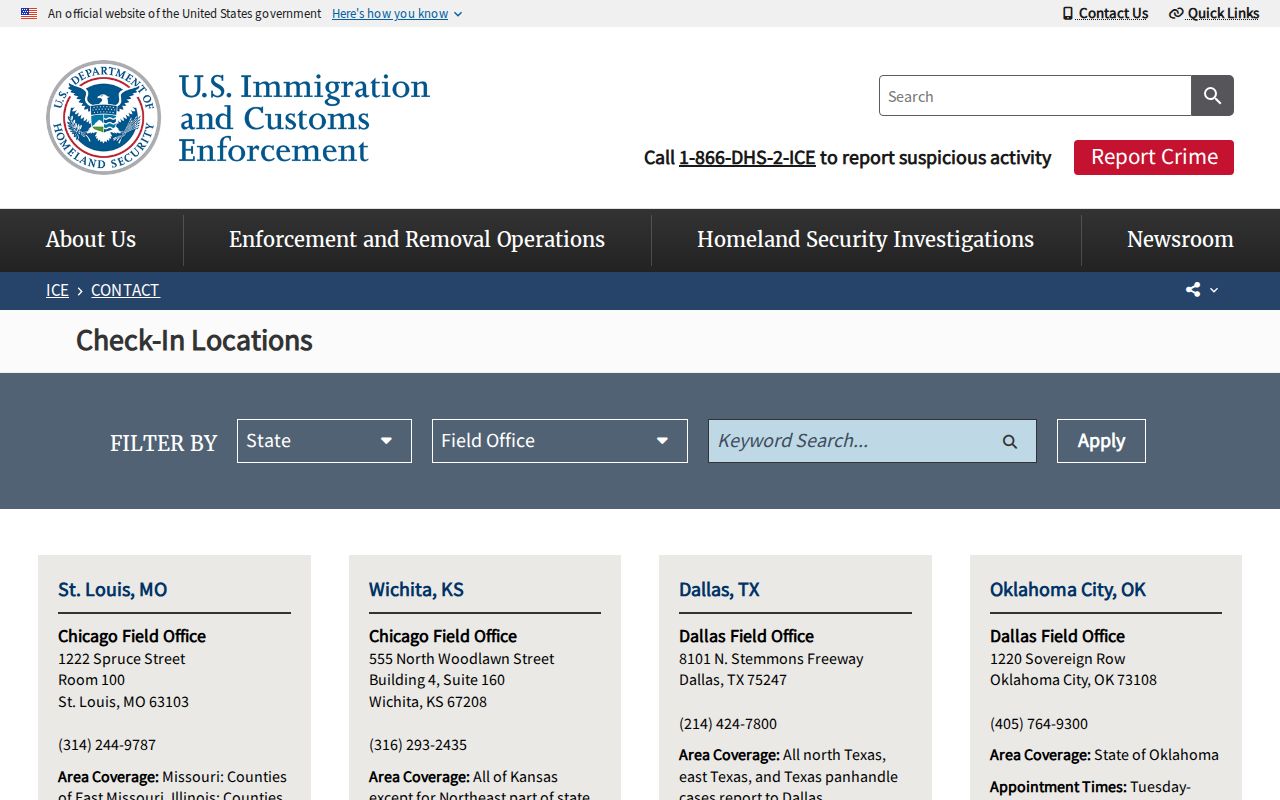
The office listing helps route a direct question after a locator search. It does not establish that the person was housed at SEORJ, released in Ohio, or assigned to a specific Vinton-area office.
SEORJ ICE Release Transfers
The bounded official sweep found no evidence that Southeastern Ohio Regional Jail is an ICE detention-contract facility. That negative finding should not be turned into a claim that an individual can never have an immigration detainer. If a named record shows one, verify the departure with SEORJ and the next status through ICE. The absence of a documented hold should not be replaced with speculation.
A Vinton-serving jail transfer record is the key bridge. It may show the date and time the person left, the disposition as transfer, and the receiving agency. When Sheriff Ryan Cain's office made the arrest, its official Vinton County page is the arrest-side contact. The Vinton County Court route can explain a local case result, while ICE or the federal court explains the next stage. The SEORJ release page identifies the local record fields to request.
Neither geography nor timing proves destination. SEORJ sits in Nelsonville, outside Vinton County, while federal custody can move a person across districts or states. A separate transfer to the Ohio Department of Rehabilitation and Correction or later Adult Parole Authority supervision belongs to the state record, not ICE. Confirm the identifiers in every record. A shared name and a close date are not enough when the A-number, federal case number, Jail ID, or date of birth conflicts.
ICE Federal Release Boundaries
BOP, ICE, and the Marshals solve different search problems. BOP covers sentenced federal prisoners within its record scope and can show past release dates. ICE covers immigration detention through its limited public locator. The Marshals manage federal pretrial and fugitive custody but provide no public name locator. SEORJ and ODRC remain separate local and state systems.
Start with the record that names the custodian. A federal case number points to the federal docket. An A-number points to ICE. A BOP register number points to the BOP locator. A Vinton case number and SEORJ Jail ID point to the local jail and court. This source-first method prevents a transfer from being mislabeled as freedom and prevents an unrelated federal result from being attached to a local case.
Dates also need source labels. A local departure time, an ICE booked-out date, a federal court order, and a BOP release date can refer to different stages. Keep the agency name beside each date when building the sequence. If two dates conflict, ask each office about its own record rather than choosing the date that seems most convenient. Save the A-number or case number with each agency response.